

10 years ago, Dr. Megan Coffee— a doctor who expanded the horizons of what it means to be a physician— hopped on a flight to Haiti in response to the earthquake shattering the lives of 3 million Haitian citizens. Little did she know the short trip she had planned would shape the rest of her life, but more importantly, the lives of thousands of Haitian people.
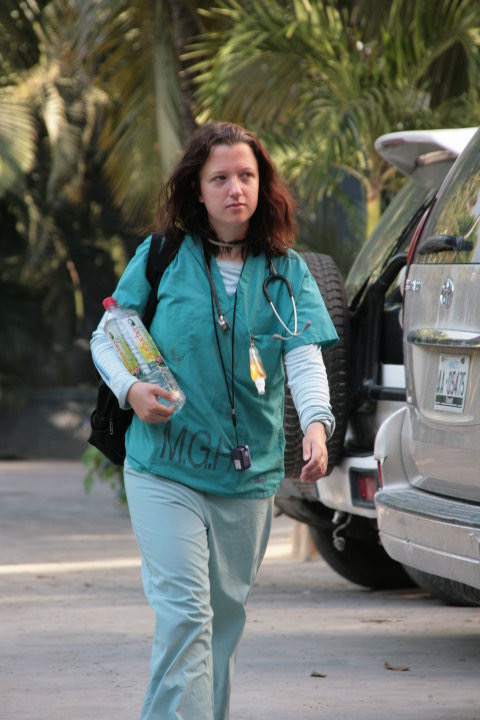
Dr. Megan Coffee majored in chemistry at Harvard University, went to Oxford to get her doctorate of philosophy in Infectious disease mathematical modeling, MD from Harvard Medical School, and completed residency at Massachusetts General Hospital leading to her earning an M.D. and Ph.D. in Infectious Diseases. She was completing her fellowship at UCSF when she received a call from her friend from the U.S. whose family is Haitian that the situation there was a nightmare. With little hesitation, a few boxes of N-95 masks, HIV medication for the patients, and enough personal belongings for a temporary trip, she set off to Haiti using the vacation days she had.
Many of the physicians who arrived in Port-as-Prince from abroad specialized in emergency room medicine or surgery, but there was a lack of those who specialized in infectious diseases. Working with her friend’s uncle, who had been trained in Haiti, she planned on just staying for two weeks and treating orthopedic infections, treating injuries related to collateral damage from the earthquake, and providing disease care. Still, when she discovered that there was no one to run the Tuberculosis Unit, although there was no pay, she took the challenge upon herself and never looked back.
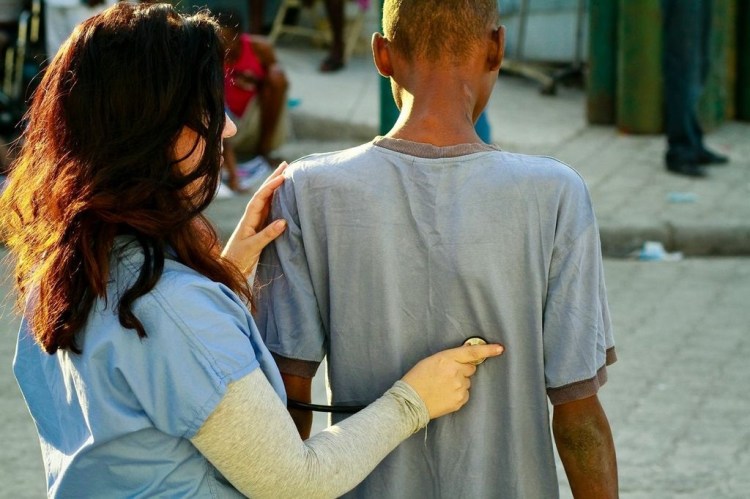
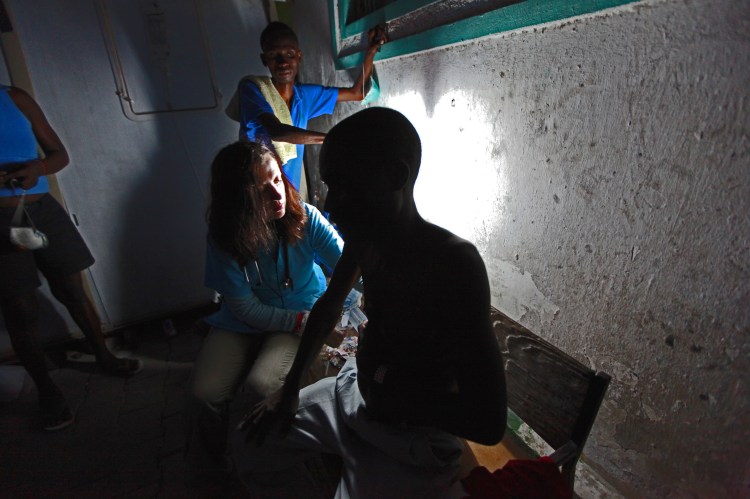
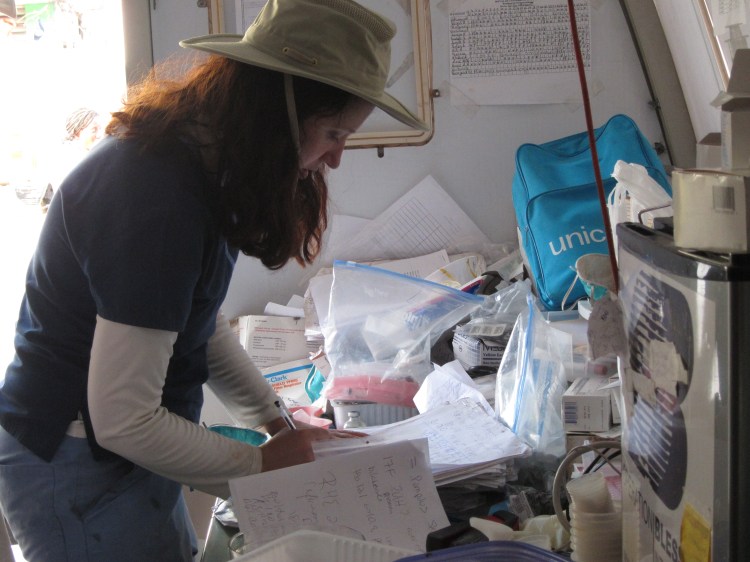
Working conditions in Port-au-Prince were far from ideal, but Dr. Coffee made them work. She traveled to the care unit early in the morning by Tap-tap, the bus service of colorfully painted buses in Haiti. The first item on her agenda was to make sure all the patients had proper oxygen levels and were well-accommodated. The care unit initially consisted of 1 white tent and 1 blue tent, the nursing station, sitting in a large parking lot. They later added 2 more tents giving them space for 70 patients. At the time, many could still feel the aftershocks, but the more significant concern would be if some of the buildings collapsed in response to the aftershocks. So, the care unit, as well as millions of Haitians, spent days and nights outdoors. Although being outside allowed safety from collapsing buildings, a problem with equal concern was raised. While Haitians now walked around, breathing the same air and coming into contact with more people, the susceptibility of one to inherit an infectious disease grew. As the number of patients increased, the need for oxygen was vital and at high demand, but unfortunately, it did bare an expensive cost.
Recognizing that many people worldwide are unaware that Tuberculosis is still a prevalent disease that needs to be taken care of, Dr. Coffee started the non-profit organization Ti Kay Haiti in 2011. With her medical expertise and knowledge of the subject, she believed that she needed to be a voice for those in need. Ti Kay means “”Little House”” in Haitian Kreyol. Its name originated from the idea that Tuberculosis is the disease of the small house where people are quarantined. Ti Kay Haiti’s objective is to stop the spread of Tuberculosis and HIV while preventing the illness and death caused by the diseases. It exists to support local people in Haiti personally affected by Tuberculosis and HIV. Dr. Coffee continues to run Ti Kay Haiti from the United States today.
Tuberculosis is a disease that can be acquired by just breathing, and kills and has killed more people than any other infectious disease. People with HIV are more likely to have a bad case of Tuberculosis, but anyone can have it. In fact, many of Megan’s patients were healthy 16 years olds. Furthermore, drug resistance is an issue, as 3 drugs must be taken to treat TB, and if only 1 or 2 are taken, an individual can end up fostering resistance leading to, in most cases, death. It is a disease that dwells in the air for long periods and does not necessarily need direct contact to spread. When homes do not have proper ventilation or airflow, the inhabitants have a greater chance of inheriting the disease. Initially, 3 in 1000, people were expected to have it, but quite fortunately, over the past 2 years, the stats have been reduced. Ti Kay Haiti has been able to successfully treat thousands to this day.
Through the years, Dr. Coffee developed the understanding that diseases are simply not fair. They are not fair in the sense that they target those who are vulnerable and can go on to portray some fault lines in society. In fact, that is precisely what drove Dr. Coffee to study infectious diseases, and although she decided her direction of study early on, she never imagined or planned that her life would end up the way it did. Some challenges she faced included the doubt people placed in her for being a woman in the healthcare industry. One instance included when one asked if there was a doctor on a plane, and when she stepped forward, they remarked condescendingly that they needed a doctor and not a nurse. As I mentioned in Rosie Gundra’s post, gender inequality is still a prevalent issue in the world today and not something to overlook. The quality of one’s work must be assessed, extracting any prejudice.
Back in Haiti, Dr. Megan Coffee went above and beyond the ordinary expectation for each patient. If patients were not provided enough care by the care unit, she went out of her way to buy materials with them with her own money for their necessities. As she is both a researcher and a physician, she says that to help a patient to the utmost capability, one must learn about the patient through research and see them face to face. She even included, “If you don’t know those people face to face, they are not your patients.”
The most extraordinary thing about Dr. Coffee is that she does not think she is extraordinary. When I interviewed Dr. Coffee via Zoom call, she was extremely kind and confident, but had such a humble personality as she drew more attention to the people who have impacted her life and what her work is achieving than to herself. For example, she proudly spoke about the 12 nurses at the care unit who kept her well and lovely Sister Mary who was the first to let Dr. Coffee stay with her in Haiti. What stood out most to me is that Dr. Coffee never looked for recognition for her work, and that is precisely what is so special about people who devote themselves to serving the world. What matters most to them is the next problem they must conquer rather than who’s watching. Their job is never finished until the problem is defeated. Dr. Coffee may have had to leave Haiti, but Haiti never left her. She even stated, “I am not planning on leaving this project. I just want it to be more sustainable. No one person could do all that we’ve been doing for this TB program. It needs to have a lot of people and systems in place to make it continue working, no matter what.” Today, Dr. Coffee balances the Ti Kai Haiti program, works as an attending at a hospital in New York City, teaches classes as a clinical assistant professor at NYU, instructs a course about infectious diseases and humanitarian crises, works as an advisor of communicable diseases, and practices as a telemedicine doctor. Although she has a heavy workload, she makes time for any setback she sees in the world. Her advice is to trust your gut feeling because, in most cases, you had the feeling for a reason and to let life take you as it may, as you never certainly know what your future will look like. Additionally, she believes there is always a system to strengthen and people on the ground who want to help; it’s essential to build sustainable programs where you’re at.
By learning about influential people like Dr. Megan Coffee, the world can develop a greater understanding of just how capable we are. In many cases, I see people underestimating themselves, thinking they can’t do something or not making a lifestyle change because they are afraid of not being comfortable. Still, sound change and innovation come after stepping out of one’s comfort zone. The moment we see that the world will start to improve, our ocean of problems will begin to disappear.
If you’d like to learn more about Ti Kay Haiti or donate, the link is attached below! https://tikayhaiti.org/
 Rising Echo
Your insight into the phenomenal work Dr. Coffee has been doing is an eye opener to us to avail ourselves more for the greater good. Kudos to Dr. Coffee for selflessly working for Haitian people who have lost so much but gained greatly by having this inspiring humanitarian by their side. I salute her for the empathy and the generosity she so unwaveringly gives to the people who needs it at their worst time. Great work, Misha!
LikeLike